Wednesday, May 27, 2020

Spanish dig closes in on burial site of Irish lord Red Hugh O'Donnell

Somewhere beneath a street in north-west Spain – probably between a bank branch and a budget clothes shop – lies the ruined chapel where an eight-toed, rebel Irish lord was buried following his final, fatal mission 418 years ago.

Red Hugh O'Donnell, who escaped captivity and led a rebellion that almost expelled the Tudor English forces from Ireland, fled to Spain after the battle of Kinsale in 1602 when the rebels tried to team up with a beleaguered Spanish expeditionary force.

He came to the country to lobby for a fresh Spanish invasion but died of a suspected tapeworm infection near the city of Valladolid aged 29.

Four centuries after O'Donnell's death, investigators and archaeologists in the city are hunting for the chapel where he was buried – and which also held the body of Christopher Columbus before the explorer's remains began a long, intercontinental voyage of their own. Three years after he was buried in the Valladolid monastery, Columbus's remains were moved to Seville and later sent to the Caribbean. After a sojourn on the island of Hispaniola – present day Haiti and the Dominican Republic – they went to Cuba before returning to Seville in 1898.

Efforts to locate the Chapel of Wonders, which was part of Valladolid's huge St Francis monastery, began last year after an Irish visitor asked the local authorities if anyone knew where O'Donnell lay.

Óscar Burón, an architect for the city council, was one of those consulted. A year on, Burón, his fellow investigator Juan Carlos Urueña and a team of archaeologists are into their second week of excavations and believe they are closing in on the chapel.

"The monastery, which had been built at the end of the 13th century, was the most significant in the city in terms of both size and importance," said Burón.

By the time O'Donnell died in the nearby village of Simancas, he added, Valladolid was serving as the seat of the court of Philip III and the monastery would have been "at the height of its splendour". But the site was sold and destroyed in 1836 during a wave of monastic expropriations.

Using records, digital technology and the only surviving plan of the monastery, which dates from 1835, the team set about looking for the chapel.

"We've been piecing together the plans and looking for the trail over the past 200 or 300 years to find out where certain walls and lines are now," said Burón.

"Now it's just a question of putting that together – and praying a lot. On Monday morning, the archaeologists said they'd come across another of the walls we were expecting to find, which means we're getting very close."

The dig in the centre of Valladolid, Spain. Photograph: Jesús Guerra

The project has turned up hundreds of bone fragments and on Wednesday found six more-or-less intact skeletons, leading the team to suspect they are already in or around the Chapel of Wonders.

The dig has attracted considerable interest from Ireland, where O'Donnell remains a romantic – and romanticised – figure, and a symbol of defiance on a par with Scotland's William Wallace. O'Donnell was born in 1572 in what is today county Donegal, a north-west corner of Ireland that had held on to its Gaelic identity and independence against English encroachment.

He clashed with local rivals, raided cattle and pillaged much of Galway but Irish schoolchildren tend to focus on 1592 when he escaped imprisonment in Dublin castle and lost two toes to frostbite while fleeing over the Wicklow mountains.

With his father-in-law, Hugh O'Neill, he led a nine-year campaign that scored notable victories against Queen Elizabeth I's forces before defeat at the Battle of Kinsale. From there, he struck out for Spain.

"He was a formidable operator – powerful and probably quite charismatic," said Jane Ohlmeyer, professor of modern history at Trinity College Dublin and author of Making Ireland English: The Irish Aristocracy in the Seventeenth Century.

"He was a very significant regional powerbroker and periodically a thorn in the side of the English crown. Taking him out would have been a priority for Queen Elizabeth and her officials in Ireland."

Were they to be found, his remains could yield DNA that would confirm or scotch a theory that he was poisoned, said Ohlmeyer. "You can tell a lot from people's bones. They could tell us not only how he died but how he lived."

Burón, however, is adamant that no one should be holding their breath. The monastery was used as a burial site for hundreds of years and the bones it held were churned and mixed up when it was destroyed in 1836. And besides, he added, real-life archaeological quests seldom end as neatly as they do in Indiana Jones films.

"People in Ireland are hoping that a skeleton missing two toes will turn up and that it'll be poor old Red Hugh," said the architect. "But it would be impossible to do a DNA test on each of the 300 or 400 bone fragments we've found – unless a Bill Gates-type wants to come along and spend their millions on it."

For him and the rest of the team, the project is about much more than bones, no matter how illustrious. "What we're doing is trying to locate the chapel where Columbus and O'Donnell were so that the site can get the respect it deserves," said Burón.

"It's important for the people of Valladolid and important for the people of Ireland. This monastery was one of the biggest in Spain at the time and it's very sad that a place with so much heritage and history was lost overnight. It's so valuable and yet it's been forgotten."

Germany aims to lift debt ceiling for rail operator Deutsche Bahn

BERLIN, May 27 (Reuters) - German Chancellor Angela Merkel's ruling coalition plans to allow state-owned rail operator Deutsche Bahn to incur more debt to cushion it from the collapse in travel due to the coronavirus crisis, a document showed on Wednesday.

Lawmakers from Merkel's conservatives and Finance Minister Olaf Scholz's Social Democrats have agreed to lift the debt ceiling by 5 billion euros ($5.5 billion) to 30 billion euros this year, according to the draft parliamentary resolution obtained by Reuters.

The higher debt ceiling should help Deutsche Bahn, whose passenger numbers have dropped due to COVID-19 restrictions, plug a budget hole of between 11 billion and 13.5 billion euros through 2024.

While trains have continued to run during the pandemic, Deutsche Bahn says the number of passengers on long-distance routes is at around 10-15% of normal levels.

Transport Minister Andreas Scheuer is expected to brief lawmakers on parliament's budget commit tee about Deutsche Bahn's business problems later on Wednesday.

The higher debt ceiling is part of a proposed rescue package that also envisages government cash injections of at least 5.5 billion euros and cost cuts of about 2 billion euros from the company's wage bill.

The company is looking to borrow up to 8 billion euros this year alone, according to a draft document prepared for the supervisory board and seen by Reuters on Tuesday. This would push up overall debt at Deutsche Bahn to 30 billion euros.

The government and trade unions have not yet finalised details of the contribution of employees to the rescue package as the company has ruled out dismissals, meaning savings can only come from wage freezes or longer working hours.

The plan also needs to be approved by the European Commission, given competition issues for the railways sector.

($1 = 0.9101 euros) (Reporting by Holger Hansen and Michael Nienaber; Editing by Pravin Char)

Canada wants national sick leave plan in place for second wave of the coronavirus pandemic

I've been able to go to the beach here in Canada pretty much all throughout, except during the initial wave when we were asked to avoid these things until our government understood what was happening.

We've been asked to avoid gatherings, keep apart from people in public, stay home and/or wear a mask if sick (even if not covid) and wash our hands / sanitize our hands as much as possible.

By just following the basic rules, we can both live our lives to some extent and keep everyone in our community safe.

It takes very little effort to defeat what is a huge human problem. It makes no sense to me that people protest so strongly. They'll scream and yell about patriotism and personal responsibility until they actually have to show some patriotism and personal responsibility.

Tuesday, May 26, 2020

The largest lockdown in the world is ending. India is bracing for what comes next.

Now India is bracing for what comes next. While the lockdown slowed the spread of the novel coronavirus, experts say, it did not succeed in flattening the curve. Instead, the number of fresh cases is rising. India ranks fourth in the world in the number of new cases a day: Only Russia, Brazil and the United States are adding more. India has more than 150,000 cases.

In recent weeks, the government has relaxed curbs on movement, transportation, commerce and manufacturing. Large gatherings remain prohibited, and ­international flights are still banned. But experts say loosening the restrictions means cases will increase at faster rates. That will intensify pressure on hospitals already under strain and will affect access to health care overall.

India’s two largest cities â€" Mumbai and Delhi â€" are preparing for a surge in cases. In Mumbai, the nation’s hardest-hit city, beds in some coronavirus wards are already full and the local government asked another state to send doctors and nurses to help. In Delhi, authorities are turning yet another major ­government-run hospital into a center for coronavirus patients and just ordered all private hospitals to reserve 20 percent of their beds for such cases.

“It is going to be a mess,” said Jayaprakash Muliyil, a leading Indian epidemiologist. In a city as densely populated as Mumbai, “trying to control any viral transmission is next to impossible.”

Mumbai, India’s financial capital, now has more than 31,000 confirmed cases. “Our covid wards have been full for the past three weeks,” said Lancelot Pinto, a pulmonologist at P.D. Hinduja Hospital, a large private hospital in the city. “We’ve had to turn away patients.”

India’s government has dramatically shifted its approach to the pandemic. In March, Prime Minister Narendra Modi announced one of the strictest lockdowns in the world with hours’ notice at a time when the country had a little over 500 recorded cases. Staying indoors for 21 days would be necessary to “break the chain of infection,” he said, expressing confidence that India would “emerge victorious.”

When Modi addressed the nation earlier this month, however, talk of stopping or defeating the virus was gone. The virus will “remain part of our lives for a long time,” he said. Restrictions would be loosened, with much of the decision-making left to individual states.

The shift is an acknowledgment of the economic devastation caused by the shutdown in a country where there is little social safety net. The Indian economy is expected to shrink in the current financial year for the first time since 1980, and more than 100 million people have lost their jobs.

Government officials have highlighted the fact that India’s death toll remains comparatively limited, with about 4,300 deaths recorded so far and a mortality rate of 2.9 percent. In the United States, that figure is 5.9 percent.

The lockdown gave India crucial time to prepare without facing an “overwhelming” number of infections, V.K. Paul, a member of the government’s planning arm, said in a briefing last week. The country is “ready for the coming challenge,” he said.

Paul declined to share any predictions for how fast cases would rise (as recently as last month he shared a chart indicating that they would fall). A model developed by statisticians and epidemiologists at the University of Michigan is predicting that India will have nearly a million cases by July 15 if there is a “cautious” resumption of activity after the lockdown.

“In India, the curve hasn’t turned the corner,” said Bhramar Mukherjee, a biostatistician who leads the project. “You have deferred the peak.”

There remains skepticism about whether the official figures on cases and deaths capture the true scope of the outbreak. The country has significantly ramped up its testing capacity over the last two months â€" it now conducts about 110,000 tests a day â€" but in a nation of India’s size, that translates into a tiny percentage of the population.

Testing in India remains “inadequate,” said K. Sujatha Rao, who formerly served as the top civil servant in the country’s Health Ministry. The stigma surrounding the disease also represents a “serious deterrent” to getting people tested in the early stages of the illness, she said.

The nationwide figures obscure considerable variations in the pandemic response across a vast nation. The southern state of Kerala mobilized its robust public health system to track, treat and isolate people who tested positive. The number of active cases in the state dropped to just 16 earlier this month. But confirmed cases in the state are rising once again as residents begin to return from other parts of India or via special repatriation flights from abroad.

The virus is exposing well-known weaknesses in India’s rickety health infrastructure, particularly in government-run hospitals that are the primary option for the country’s poor. A panel of judges in the western state of Gujarat recently said that the main public hospital for treating covid-19 patients in the city of Ahmedabad was “as good as a dungeon, maybe worse.”

Accessing health care â€" which can be a challenge for the poor under normal circumstances â€" is becoming even more difficult in some places. During the long lockdown, many hospitals postponed elective surgeries and shut down outpatient departments altogether to minimize the risk of infection. Some hospitals in Mumbai and Delhi temporarily suspended some operations and stopped taking new patients after members of their staff tested positive.

R.V. Singh Pundhir sold tractors in the northern Indian city of Agra, home to the Taj Mahal. The 64-year-old had kidney disease and needed regular dialysis treatment. In April, his normal clinic shut down after positive cases were found nearby, his daughter Akansha Pundhir said. A few days later, he woke up with difficulty breathing.

His family rushed him to a nearby public hospital, which said it did not have the ability to do dialysis. A private hospital told him to come back later, then asked for a test to show that he did not have the coronavirus. But it was already too late: Pundhir died in a car parked outside the hospital. His test result came back negative later the same day, his daughter and a neighbor said.

“We couldn’t believe what was happening,” said Akansha Pundhir, 23. “We kept thinking some hospital would take action.” The death of her father was “completely avoidable.”

Tory unrest increases pressure on PM to sack Dominic Cummings

Boris Johnson faced an extraordinary and growing revolt from within his own party on Tuesday over his refusal to sack his chief adviser, Dominic Cummings, for breaching lockdown rules.

On a day of dramatic developments, a junior minister resigned and more than 30 other Conservative MPs called for Cummings to go, many citing inboxes overflowing with hundreds of angry messages from constituents.

A further eight Tory MPs were publicly critical of the senior aide's actions, and three said privately that he should be forced out.

Downing Street had hoped Monday's lengthy statement from Cummings in the rose garden of No 10 would convince the public he had acted as any concerned father would in driving 260 miles to his parents' property in Durham when his wife was experiencing potential coronavirus symptoms.

But in a snap YouGov poll, 71% of respondents said they thought Cummings had broken the rules, and 59% that he should resign – up seven percentage points from three days earlier. Forty-six per cent of Tory voters and 52% of leave voters said he should quit.

A separate YouGov survey for the Times suggested the Conservative lead over Keir Starmer's Labour party has been cut by nine points in a week: the sharpest fall for a decade. The poll put the Tories on 44% and Labour on 38%.

As the number of excess deaths registered in the UK during the Covid-19 outbreak reached nearly 60,000, and an international comparison confirmed the country has one of the world's highest rates of coronavirus deaths per capita, the Downing Street press briefing was dominated by questions about Cummings for a fourth consecutive day.

It follows an investigation by the Guardian and Daily Mirror revealing Cummings' previously secret trips to and around north-east England in late March and early April.

Douglas Ross, the MP for Moray who stepped down as a Scotland Office minister, said that although he accepted Cummings had acted with his family's best interests at heart, "Mr Cummings' interpretation of the government advice was not shared by the vast majority of people who have done as the government asked".

He added: "I have constituents who didn't get to say goodbye to loved ones; families who could not mourn together; people who didn't visit sick relatives because they followed the guidance of the government. I cannot in good faith tell them they were all wrong and one senior adviser to the government was right."

Cummings insisted a caveat about parents looking after young children legitimised his decision to drive to Durham, saying: "The guidance says you don't have to just sit there."

The prime minister has staunchly defended his most senior aide, whose advice was critical in sweeping the Conservatives to an 80-seat majority, with the "Get Brexit done" slogan, at December's general election.

Significant revolts are rare at such an early stage after a thumping election victory, but Cummings was already a divisive figure and his refusal to apologise for an apparent breach of the rules appears to have touched a nerve with the lockdown-weary public.

Calls for him to go came from across the spectrum of the Conservative party on Tuesday.

They included the former chief whip Mark Harper, who said there was "no credible justification" for the drive to local beauty spot Barnard Castle, apparently to test whether Cummings' eyesight was good enough to make the drive back to the capital.

'I don't regret what I did': Dominic Cummings faces journalists' questions – video

The former health secretary Jeremy Hunt released the text of a reply to a constituent, in which he said of Cummings: "What he did was a clear breach of the lockdown rules" – though Hunt did not call for him to resign, saying: "You do make mistakes in these situations."

Four more former ministers – Steve Baker, Harriett Baldwin, Stephen Hammond and Jackie Doyle-Price – all called for Cummings to go.

The veteran Brexiter Peter Bone said he had not been reassured by Monday's statement. "The rose garden interview just confirmed to me that he had driven up to Durham when we were in a strict lockdown. He absolutely should resign," he said.

"I have 400 emails from people and I'm sitting here with my colleague going through every one, and we'd rather be doing some case work but we just have so many people to reply to."

Johnson loyalists continued to defend the embattled adviser on Tuesday, however. Cummings' longtime political friend and former boss Michael Gove gave a series of supportive interviews, insisting the Barnard Castle side trip was wise.

"I think he was wise to make sure he was comfortable before driving back down to London on the A1, an inevitably busier road," he told Sky News.

Gove also said: "It is the case it was part of the National Police Chiefs' Council's guidance that you could drive at that time to take exercise as well." However, the rules on exercise were only relaxed after Cummings was back in London.

Q&A Covid-19: Help us investigate Show Hide

The Guardian is investigating how the UK government prepared for – and is responding to – the coronavirus pandemic. We want to learn more about recent decisions taken at the heart of government. If you're a whistleblower or source and with new information, you can email investigations@theguardian.com or (using a non-work phone) send us a Signal or WhatsApp to this number (UK) +44 7584 640566. (The number does not take calls.) For the most secure communications, use SecureDrop and for general advice on confidentially contacting the Guardian see our guide.

Later, the health secretary, Matt Hancock, who is the minister responsible for the lockdown regulations, repeated his own defence of Cummings, insisting: "My view is that what he did was within the guidelines."

Asked why he himself had stayed put when he and his wife were ill with the virus, Hancock told the Downing Street press briefing bluntly: "We had childcare readily available at home, and Mr Cummings didn't."

But Hancock was blindsided by a question from a vicar in Brighton about whether members of the public who had been fined for travelling during the lockdown could have them reviewed if they were travelling for childcare reasons.

"It's a very good question and we do understand the impact and the need for making sure that children get adequate childcare, that is one of the significant concerns that we have had all the way through this," he said.

Matt Hancock to 'look at' fines given to families who broke lockdown for childcare – video

He then said he would speak to colleagues at the Treasury about the issue. Government sources later insisted he had not intended to promise a review, and it would be looked into by the Home Office.

Downing Street has not yet announced a replacement for Ross – and could struggle to find another supportive Scottish Tory MP. The party's leader in Scotland, Jackson Carlaw, who is an MSP, told the BBC on Tuesday that the Cummings "furore" was a distraction, and if he were Cummings, he would "be considering my position".

During his briefing on Monday, Cummings insisted he had not considered resigning and did not regret his various journeys – though he did concede that perhaps he should have discussed his whereabouts with the prime minister at an earlier stage. He said Johnson found out a few days later, but nothing was made public.

Labour sought to pile the pressure on Johnson, with the shadow chancellor, Anneliese Dodds, writing to her Conservative opposite number, Rishi Sunak, to ask if the government has modelled the risks of declining compliance with the lockdown rules.

Without mentioning Cummings by name, she said she was "deeply concerned that the last 48 hours have presented a confused picture" about whether those experiencing symptoms should self-isolate.

Twitter tags Trump tweet with fact-checking warning

Twitter tags Trump tweet with fact-checking warning
  • 27 May 2020
  • These are external links and will open in a new window
  • Share this with Messenger
  • Share this with Messenger
  • Share this with Pinterest
  • Share this with WhatsApp
  • Share this with LinkedIn
  • Copy this link

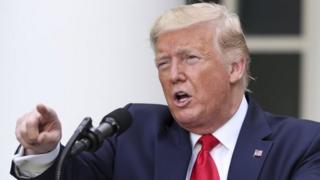
    Read more about sharing. Close share panel US President Donald Trump. Photo: 26 May 2020Image copyright EPA Image caption Donald Trump accused Twitter of interfering in the 2020 presidential election in the US
    A post by US President Donald Trump has been given a fact-check label by Twitter for the first time.

    President Trump tweeted: "There is NO WAY (ZERO!) that Mail-In Ballots will be anything less than substantially fraudulent."

    Twitter put a warning label under the post and a subsequent tweet under its new policy on misleading information.

    Mr Trump responded by tweeting again, saying the social media giant "is completely stifling free speech".

    Twitter's notification displays a blue exclamation mark underneath the tweets, suggesting readers "get th e facts about mail-in ballots".

  • Coronavirus: Twitter will label Covid-19 fake news
  • What is Twitter saying about Trump's posts? Image copyright Twitter

    Twitter's link directs users to a page on which Mr Trump's claims about mail-in ballots are described as "unsubstantiated". The social media company cites reporting on the issue by CNN, the Washington Post and others.

    This is followed by a "what you need to know" section where Twitter corrects what it says are false claims by the US president.

    The social media company had pledged to increase the warning labels under false or misleading information on its site - but it has been slow to take steps against the US president.

    Twitter updated its policies on warning labels early this month.

    What is President Trump's response?

    In his new tweets, Mr Trump accused Twitter of interfering in the US presidential election scheduled for 3 November 2020.

    He said that the social media company was "completely stifling free speech, and I, as president, will not allow it to happen".

    Mr Trump's presidential campaign manager Brad Parscale also criticised Twit ter.

    "Partnering with biased fake news 'fact checkers' is a smoke screen to lend Twitter's obvious political tactics false credibility. There are many reasons we pulled all our advertising from Twitter months ago, and clear political bias is one of them," Mr Parscale tweeted.

    Only the first test for Twitter

    Analysis by BBC's Technology reporter Zoe Thomas

    President Trump has used Twitter as a platform to pick fights with other politicians and celebrities. Now he may be in for a fight with the platform itself.

    Following the firm's decision to label his tweets as misleading, he claimed on Twitter that the company was stifling free speech and that he wouldn't allow it. But Twitter as a private company gets to set its own rules for what happens on its platform.

    The trouble for many was that up until Tuesday the firm didn't seem to be enforcing its rules when it came to the US president or other global leaders.

    This is not the first time President Trump has made claims on Twitter that some say would have gotten less powerful people blocked from the site.

    But Mr Trump's bombastic comments are part of what draws some of his more than eight million followers to the site in the first place. The company doesn't want to lose them.

    It sees the new labelling system as a way to balance both the desire to allow Twitter users including the president to say what they like, while also giving readers protection against misleading claims. The strategy mostly worked with tweets about Covid-19.

    But with the US election in November, Twitter should expect a lot more posts with potentially misleading information. Meaning this is likely only the first test for its new enforcement plans.

    What are mail-in ballots?

    They are voting bulletins that are distributed and returned by post.

    Image copyright Reuters

    In a recent opinion survey conducted by the Pew Research Center, 66% of Americans said they would not be comfortable going to a polling place to cast their ballot during the current coronavirus outbreak.

    Such concerns have increased pressure on states to expand the availability of mail-in ballots for all voters in order to minimise the risk of viral exposure from in-person voting.

    While every state provides some form of remote voting, the requirements to qualify vary greatly.

    Five states in the western US, including Washington, Oregon and Colorado, conduct their elections entirely via mail-in ballot.

    Others, like California, provide a postal ballot to anyone who requests it.

    On the other end of the spectrum, 17 states require voters to provide a valid reason why they are unable to vote in -person in order to qualify for an absentee ballot.

    Twitter refuses to remove 'horrifying lies'

    The move comes on the heels of Twitter's decision not to remove comment President Trump made about the death of Lori Klausutis in 2001.

    The president has tweeted several messages promoting a conspiracy theory that Ms Klausutis was murdered by MSNBC host Joe Scarborough.

    Her widower Timothy Klausutis asked Twitter to remove the post, saying it included "horrifying lies".

    The company declined to take down those tweets but told Mr Klausutis it was "deeply sorry" about the pain caused by the president's statements.

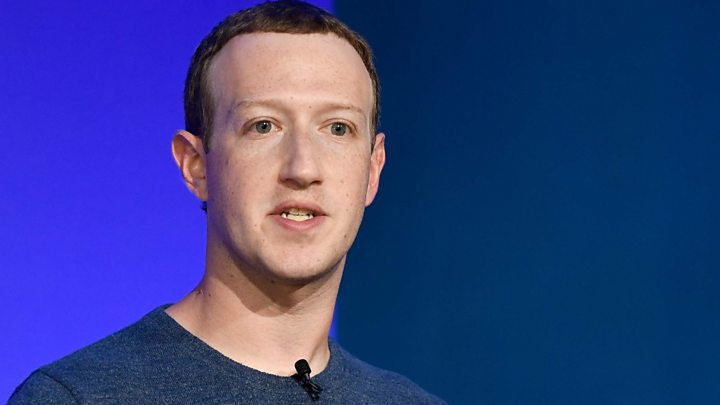
    You may also be interested in Media playback is unsupported on your device Media captionMark Zuckerberg told the BBC's Simon Jack that Facebook would 'take down' coronavirus misinformation

    She was tricked as a teen into prostitution. A decade on, she has no work and faces starvation

    Daulatdia, Bangladesh — Nodi was 14 years old when she says she was deceived and sold into one of the world's biggest brothels.

    Already married with a young baby, she had gone to look for her husband, who was known to gamble in the area in eastern Bangladesh. Nodi says she met a driver who offered to help, but he turned out to be a broker, who sold her to a madam in the Daulatdia brothel complex.

    "I was tricked," said Nodi, who only wants to be identified by the first name that she uses with clients. "Then I got trapped here."

    Once her husband and family found out what had happened, she says they refused to rescue her, due to the shame associated with the brothel.

    More than a decade after she was sold and abandoned -- and with Bangladesh under lockdown to prevent spread of the Covid-19 virus -- the 25-year-old is facing a new problem: hunger.

    There are approximately 1,500 women in the Daulatdia brothel, who get paid as little as $2 for sex by the 3,000 male customers who usually visit every day.

    There are approximately 1,500 women in the Daulatdia brothel, who get paid as little as $2 for sex by the 3,000 male customers who usually visit every day.

    There are approximately 1,500 women in the Daulatdia brothel, who get paid as little as $2 for sex by the 3,000 male customers who usually visit every day.

    "Because of this coronavirus pandemic, we are now in trouble," said Nodi. "We have no work."

    In late March, Bangladesh imposed a nationwide lockdown to prevent the spread of Covid-19, which has infected more than 36,000 people in the country, including more than 520 who died, John Hopkins University figures show.

    As businesses and transport networks were shut down across Bangladesh, government-sanctioned brothels were also closed, with no clients allowed to enter. Since 2000, prostitution has been legal in Bangladesh, but it is regarded by many as immoral.

    "Our brothel has been locked down," said Morjina Begum, executive director of Bangladeshi charity Mukti Mohila Samity ('Free Woman Union' in English). "We do not allow any outside customers. Now sex workers do not have any income."

    Begum, who is a former sex worker from the brothel, added that the government, police and local NGOs including her organization are supplying relief to the women.

    But several women in the brothel told CNN that the aid is not nearly enough.

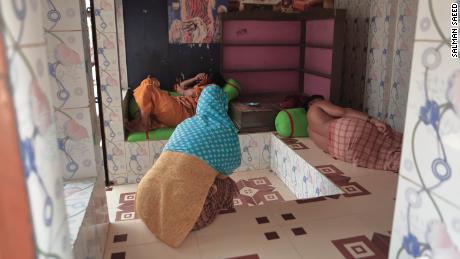
    Nearly 1,500 women and girls are packed inside the 12-acre site, which resembles an overcrowded slum, with densely packed alleyways lined with corrugated iron shacks, small shops and open sewers.

    Many of the women have given birth to children inside the brothel, and researchers say there are currently 500 children in there, including 300 under the age of six.

    "We are not getting any (food)," Nodi said. "If it continues, children will die from starvation. We pray that the virus will go away."

    Some women send their children to live with family members or at charity shelters outside the brothel, because they don't want them to be part of this life. Nodi says she has no contact with her son, now 11, who is growing up with her former in-laws in Dhaka. It's better that way, she says.

    "We want our children to be away from us so that they can become good human beings," Nodi said.

    Usually, around 3,000 men visit the brothel every day, many of them truck drivers or day laborers who stop off at Daulatdia due to its prime location next to a train station and a ferry terminal on the Padma River, a major channel running from the Ganges.

    "If it continues, children will die from starvation. We pray that the virus will go away."

    Nodi

    From late afternoon onwards, the women and girls stand around in the narrow lanes as the men walk through. Once a negotiation is complete, the clients enter one of the small rooms, which usually consist of a brightly-colored bed, and a small cupboard or wardrobe. The men pay as little as $2 for sex, and around $20 for an overnight stay.

    "Earlier I could have earned ($60) per day. Some days it could be ($20) and some days I would earn nothing," Nodi said. "Now, everything is dependent on God."

    Each sex worker in the brothel has to pay daily rent to the madams, who act as a go-between for more than a dozen landlords which own this area of land. When the girls arrive via a broker, often for a sum of around $200-300, they are forced to pay off this debt to the madams.

    A 2018 study conducted by the non-profit research organization, the Society for Environment and Human Development (SEHD), found that around 80% of the 135 sex workers surveyed said they had been trafficked or tricked into going to a brothel, said Philip Gain, the SEHD director.

    "The conditions in the brothel are so horrible," said Gain, the director of SEHD. "No-one would come unless they had been tortured or abused."

    Gain said there is a country-wide network of traffickers who find girls for the brothels, who are often persuaded with promises of well-paid work in a factory, or brought by force.

    "Once a girl is sold into a brothel, she is trapped, it is very hard to get out," Gain added.

    More than 200 girls have arrived in Daulatdia in the past five or six years after being trafficked by a broker, says Sipra Goswami, coordinator for the charity BLAST, Bangladesh Legal Aid and Services Trust, which helps to rescue underage girls from the brothels. The organization also offers the girls legal aid and accommodation in shelters, or helps them to reintegrate with their families. Most of the underage girls they rescue are aged 12-16, Goswami adds.

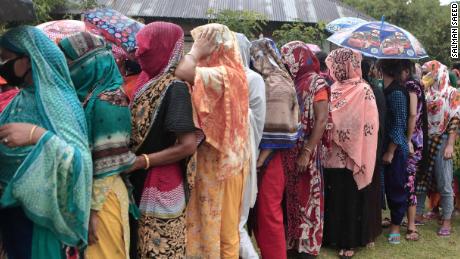
    Women queue up to receive an aid delivery at the Daulatdia brothel in Bangladesh on May 14.

    Women queue up to receive an aid delivery at the Daulatdia brothel in Bangladesh on May 14.

    Women queue up to receive an aid delivery at the Daulatdia brothel in Bangladesh on May 14.

    "They are socially excluded and vulnerable," Goswami said. "Nowadays their condition is (at the) very worst (because of Covid-19). The after effects will be awful for them."

    Local police chief Ashiqur Rahman denied there are any underage sex workers in the brothel.

    Rahman said that since he took the post in January, there have been three trafficking cases reported, adding that he tries to personally interview the women that arrive to make sure they were not forced.

    Bangladesh's Home Minister, Asaduzzaman Khan, said via text message "the law of the land prohibits trafficking in persons and there are severe penalties for the culprits. Our law enforcement agencies are vigilant and they act immediately on any such culpable crimes. Even during these extraordinary circumstances of the pandemic, we are in full alert."

    During a charity aid delivery at the brothel on May 14, hundreds of women jostled in the rain as they tried to secure one of the bags of rice being handed out; their desperation occasionally turning to frustration as tempers frayed in the crowd.

    While there are no reported Covid-19 cases in Daulatdia, there was no social distancing during the distribution, although many of the women wore masks.

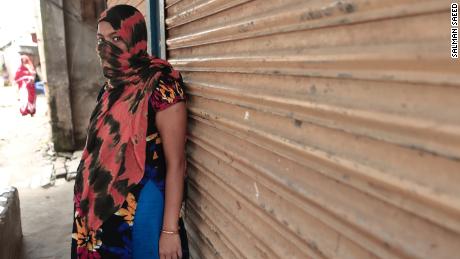
    There are around 500 children in the brothel, most of them fathered by the men who visit the complex. This woman, who did not want to give a name, says she is eight months pregnant.

    There are around 500 children in the brothel, most of them fathered by the men who visit the complex. This woman, who did not want to give a name, says she is eight months pregnant.

    There are around 500 children in the brothel, most of them fathered by the men who visit the complex. This woman, who did not want to give a name, says she is eight months pregnant.

    The local government also made an aid delivery to the brothel on March 28, which included 10kg of rice, hand sanitizer and other items for more than 1,300 women, according to Rubayet Hayat, executive officer of the local sub-district of Goalanda. He added that the country's Prime Minister, Sheikh Hasina, also arranged for 200 of the poorest women to receive a $30 cash handout via mobile payment transfer.

    The local police force -- which is guarding the brothel's entrance to stop customers entering during the lockdown -- has also made multiple deliveries of rice in the past few months, according to Rahman.

    "Firstly, we need to save their lives from the Covid," he added. "Then, we try to help with the other things.

    "We support them as much as possible, but this is not sufficient I think," Rahman said. "They are in a critical situation."

    Nodi says the relief is sometimes unfairly distributed, meaning some women are left hungry.

    "Now we are facing a lot of problems here, with the relief, some of us are getting it, and others are not," she said. "If everyone gets relief, everyone will be happy."

    Shurovi, 22, was born in Daulatdia to a mother who worked there.

    She was raised in a nearby safe home run by a charity, and received a good education before getting married and moving to Dhaka. But after four years, the couple separated when her husband found another wife.

    Shurovi, who only wants to be identified by her first name she uses with clients, had been doing some part-time work as an actress in Bangladeshi TV soaps -- a "dream job," she said. But when the work ran out, and she was left homeless after the separation, her economic situation deteriorated and she reluctantly returned to Daulatdia, a place she thought she had escaped.

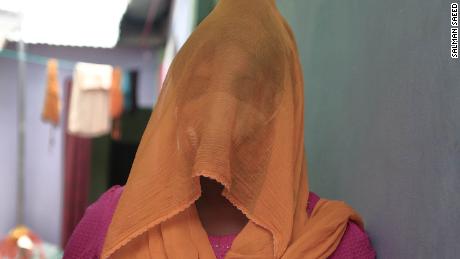
    Shurovi, 22, was born in the Daulatdia brothel to a sex worker mother. She was brought up outside by a charity, but ended up returning after her marriage fell apart and she was left homeless.

    Shurovi, 22, was born in the Daulatdia brothel to a sex worker mother. She was brought up outside by a charity, but ended up returning after her marriage fell apart and she was left homeless.

    Shurovi, 22, was born in the Daulatdia brothel to a sex worker mother. She was brought up outside by a charity, but ended up returning after her marriage fell apart and she was left homeless.

    She came back with a target: to be out of there within two years with enough money to buy some land.

    But that aim started fading after she got pregnant with her son, fathered by a client. She also had to take out a large loan to pay for an emergency C-section during the birth. And now, her exit strategy is looking more out of reach, as she spends what little she has put aside just to survive.

    "I am facing a financial crisis which threatens our survival," Shurovi said. "If I do not have any income, I cannot support my child. I cannot manage to feed myself as well as my family."

    Shurovi says she can no longer afford diapers or baby milk, which is more than $7 for a carton.

    "The support we are getting from the government is not enough," she said. "They are not providing anything for children or any cash for our family."

    "If I do not have any income, I cannot support my child. I cannot manage to feed myself as well as my family."

    Shurovi

    Shurovi's son is 10 months old, and he lives most of the time with her mother in another room within the brothel complex.

    "People who are born in these brothels, it is not their choice, they should always get a chance to live normally in society," Shurovi said.

    But the key to getting out -- and staying out -- is opportunity and support, she adds.

    "It seems like we have died before death," Shurovi said. "If the government does not think about us, we will be in great trouble."

    Salman Saeed reported from Daulatdia, Bangladesh and Rebecca Wright wrote from Hong Kong.

    Over $3 billion raised for Venezuelan refugees amid coronavirus pandemic

    MIAMI — Sixty countries pledged around $3.4 billion in emergency aid for Venezuelan refugees who have fled the economic collapse in their country and are now in neighboring nations amid the coronavirus pandemic.

    Approximately 5 million Venezuelan refugees have fled the South American country in recent years and gone to nearby countries like Colombia, Peru, and Chile. Now, as jobs have dried up in those countries due to the pandemic, thousands of Venezuelan migrant workers are seeking to return home.

    But experts warn that overcrowding in low-income neighborhoods and the lack of water in hospitals and homes create a scenario for the virus to spread quickly in the country.

    Venezuela has one of the world's worst humanitarian crises that has spiraled under President Nicolás Maduro. Its healthcare system is "grossly unprepared" for the pandemic, with shortages in medications, supplies, and interruptions of basic utilities, according to Human Rights Watch (HRW) . As of Tuesday, it had 1,177 confirmed cases of COVID-19, though HRW believes the real number is much higher "given the limited availability of reliable testing, limited transparency, and the persecution of medical professionals and journalists who report on this issue."

    Related: A former senior U.S. government official says it's the "best" deal they can get, while an analyst said this is more about "politics than policy."

    "The plight of Venezuelan refugees and migrants has worsened even further," said Filippo Grandi, U.N. High Commissioner for Refugees during a virtual pledging conference hosted by the European Union, Canada, Spain, Norway, and the United Nations. "The impact of COVID-19 is dramatic for countries across Latin America and the Caribbean and has pushed the Venezuelans living there into a spiral of poverty and despair."

    The U.S. pledged $200 million in assistance, including over $139 million in humanitarian assistance for Venezuelans in side the country and in the region. The U.S. says it is the largest single donor of assistance to Venezuelans, with a total of over $856 million.

    Story continues

    The Venezuelan government instituted a nationwide quarantine on March 17, restricting movement and ordering all businesses to close except those considered essential.

    Despite having the world's largest oil reserves, Venezuela has little gasoline as a result of mismanagement, corruption, a spiraling, and over a year of U.S. sanctions. The first of five Iranian oil tankers delivered 1.5 million barrels of gasoline to Venezuela.

    Follow NBC Latino on Facebook, Twitter and Instagram.

    Venezuela health system 'grossly unprepared' for COVID-19 crisis

    People queueing to receive food from a charity, in the slum of Carapita, during the nationwide quarantine in Caracas, Venezuela [Manaure Quintero/Reuters]

    The Venezuelan healthcare system is "grossly unprepared" to cope with the coronavirus pandemic, further "jeopardising the health of Venezuelans and threatening to contribute to spread of the disease", human rights groups and healthcare experts said on Tuesday. 

    Human Rights Watch and the Johns Hopkins University's Centers for Public Health and Human Rights said in a new report that ensuring that sufficient humanitarian aid reaches the Venezuelan people is urgently needed.

    More:

    Venezuela so far has 1,177 confirmed cases of COVID-19 and 10 deaths, but the real numbers are believed to be much higher, given the limited testing and access to reliable information.

    "The humanitarian crisis in Venezuela and the breakdown of the health system have created dangerous conditions conducive to rapid community spread, unsafe working conditions for health personnel, and high mortality rate among patients in need of hospital treatment," said Kathleen Page, a physician and faculty member of the Johns Hopkins University School of Medicine and the Johns Hopkins Centers.

    "Venezuela's lack of capacity to confront the COVID-19 pandemic may drive people to try to leave the country, further straining the health systems of neighbouring countries and imperilling regional health more broadly," Page said.

    According to the report, Venezuela's health system has collapsed amid shortages of medications and health supplies, interruptions of basic utilities at healthcare facilities, and the emigration of healthcare workers has led to a progressive decline in healthcare operational capacity.

    The report also stressed that humanitarian aid is urgently needed to assist the Venezuelan people. 

    Venezuelan citizens waiting outside the Venezuelan consulate in Quito, Ecuador to return to their country [Jose Jacome/EPA]

    According to the Global Health Security Index, Venezuela ranked among the countries least prepared to mitigate the spread of an epidemic in 2019.

    The Venezuelan government declared a state of emergency on March 13 and instituted a nationwide quarantine on March 17, restricting movement and mandating the closure of all non-essential businesses.

    The report notes that the lockdown measures are enforced by police, armed forces, a special police force called FAES, and armed pro-government gangs - leading to arbitrary arrests and harassment.

    On March 17, President Nicolas Maduro's government requested an emergency $5bn loan from the International Monetary Fund to combat the epidemic, which the IMF rejected, stating there was "no clarity" regarding the "official government recognition by the international community".

    On Tuesday, the European Union with the support of the UN Refugee Agency and the International Organization for Migration held an online international donors conference to raise funds for Venezuelan refugees, migrants and host communities. 

    More than five million people have fled Venezuela since 2015 due to political instability and economic collapse that has left many unable to obtain basic goods.

    The conference is expected to result in millions of euros in pledges that will fund humanitarian assistance and development projects in Venezuela.

    Greta Thunberg Mocks Alberta Minister Who Said COVID-19 Is a ‘Great Time’ For Pipelines: Alberta's energy minister Sonya Savage said bans on public gatherings will allow pipeline construction to occur without protests.

    Seeing this as a yes-no option is why people are frustrated with ProOil people. We don't need to become luddites and remove all traces of technology but the government actively pursuing investments in a dying business that depends on foreign processing, foreign purchasing, and high commodity pricing for the next 60 years is an objectively bad thing.

    If oil was a good idea, oil companies wouldn't sell pipelines, they'd buy them up to control supply. If they were fail safe investments we wouldn't pay (taxes) millions into fixing orphan wells. There's a middle ground that uses oil to prop up the next step of energy and manufacturing with renewable resources.

    You're never gonna fuck green space chicks if you're still burning oil to get groceries. Work with environmentalists to get better and get that crazy alien booty.

    China's military says it is prepared to protect security in Hong Kong, as protests grow

    China's military is ready and able to "safeguard" Chinese sovereignty in Hong Kong, the commander of the city-based garrison has said, amid growing anger at Beijing's plans to bypass Hong Kong's legislature and impose national security laws in the city.

    The warning came as protesters prepared for further demonstrations on Wednesday when the legislature starts debate on a controversial bill to criminalise ridicule of the Chinese national anthem.

    In an interview with Chinese state television, Chen Daoxiang, the commander of the People's Liberation Army garrison in Hong Kong, said it has the "determination, confidence and ability to protect national security" in the city.

    Despite international condemnation, protests on Sunday and further protests planned for this week, Beijing and Hong Kong authorities have refused to back down on Friday's declaration by China's National People's Congress (NPC) to impose national security laws, bypassing Hong Kong's legislature.

    Hong Kong's chief executive, Carrie Lam, maintained full support for the move, saying the Hong Kong government had been unable to pass the laws itself for 23 years, and was unlikely to in the near future.

    At her weekly press conference on Tuesday, Lam defended the legality of NPC promulgating the law as "sound and robust".

    Lam repeatedly refused to answer if the proposed laws would be retrospective – a fear held by many who organised or participated in protests last year.

    On Monday, China's senior presence in the city, the Liaison office, condemned Sunday's protests, which began peacefully but saw a heavy police response including teargas, pepper spray and water cannon, as well as two alleged protester assaults on opponents.

    It warned against "underestimating" Beijing's determination to crack down on calls for Hong Kong independence.

    "We sternly warn these people and the forces behind them not to underestimate the central government's rock-firm determination to uphold national sovereignty, security and development interests and to safeguard Hong Kong's prosperity and stability and Hong Kong compatriots' fundamental interests," the liaison office spokesperson said.

    Large protests are expected again on Wednesday, as Hong Kong legislators begin debating the national anthem bill. Authorities began sealing off areas around the LegCo building on Monday. Several days have been set aside for debate, and the vote is scheduled for 4 June – the anniversary of the Tiananmen Square massacre and another source of controversy given Hong Kong's vigil this year won't be allowed.

    Under the proposed anthem law, a person would commit an offence if they take various actions with "intent to insult" the anthem, such as changing lyrics or music or singing in a "disrespectful way". Recent booing of the Chinese anthem, March of the Volunteers, at Hong Kong football marches has embarrassed Beijing.

    The law carries financial penalties and jail time of up to three years.

    Opponents say the legislation could be weaponised against pro-democracy activists and legislators. It has already led to physical confrontations in LegCo.

    "If you show any disrespect, which is a loosely defined concept legally, they'll use it against you," says Dennis Kwok, pro-democracy lawmaker.

    "This kind of law is the hallmark of an authoritarian government, whenever they see something they don't like, they try to criminalise it. They are clamping down on freedom."

    The Hong Kong government rejected claims it suppresses freedom of speech, saying the spirit of the bill was about "respect", and an offence only occurs if someone expresses their views by publicly and intentionally insulting the anthem.

    Prominent democrat legislator Claudia Mo said the current political climate has driven opposition.

    "Things have changed in the last two decades in Hong Kong," she says. "We have reached a point of no return in not trusting this government."

    The government says it has a constitutional responsibility to enact the anthem law quickly, and has declared it a priority.

    Burundi's Nkurunziza hails chosen successor's election victory

    Burundi's President Pierre Nkurunziza has congratulated his hand-picked successor on a 'large victory' in the election [File: Evrard Ngendakumana/Reuters]

    Burundi's longtime President Pierre Nkurunziza has congratulated the governing party's hand-picked successor on a "large victory" in the country's presidential election, though the main opposition has pledged to contest the result in court.

    The election commission on Monday declared Evariste Ndayishimiye, a former army general chosen by the CNDD-FDD party as heir to Nkurunziza, the winner of the May 20 poll with 68.72 percent vote.

    More:

    "I warmly congratulate the President-elect General Major Evariste Ndayishimiye for his large victory which confirms that the great majority of Burundians adhere to the projects and the values he embodies," Nkurunziza, who chose not to run after 15 years in power, posted on Twitter.

    "We are privileged witnesses to history. May God bless Burundi!"

    Agathon Rwasa, Ndayishimiye's main challenger in a race contested by seven candidates, came in a distant second with 24.19 percent of the vote. His National Freedom Council (CNL), however, has rejected the results, alleging cheating by the CNDD-FDD.

    CNL spokesman Therence Manirambona said on Monday his party was putting together a legal complaint to submit within days "so that the court can take a decision on the massive fraud that marked this electoral farce".

    The CNDD-FDD defeated the CNL by a similar margin in the legislative elections held on the same day.

    The polls went ahead with scant regard to the coronavirus outbreak following a tense campaign marked by violence and arbitrary arrests. They also proceeded without the presence of international observers.

    On May 8, 12 days to the polls and before the scheduled arrival of an East African Community mission to the country, the government said the regional bloc's observers would have to be in quarantine for 14 days, effectively ruling them out of the election process.

    Ndayishimiye is expected to be sworn in for a seven-year term in late August, when Nkurunziza's term ends.

    Nkurunziza has been in power since 2005, and his final years in office have been racked by turmoil.

    His controversial decision to seek a third term in the last election in 2015 sparked mass unrest, violence and an opposition boycott.

    Burundi is tightly controlled by the governing party and its youth wing has been linked to a forceful crackdown against the government's critics.

    State security forces have been accused by rights groups and the UN of crimes against humanity and abuses such as torture, disappearances, sexual violence and executions.

    Ndayishimiye is set to inherit a deeply isolated country, under sanctions and cut off by foreign donors, its economy and national psyche damaged by the years of unrest.

    It remains to be seen how much influence Nkurunziza will exert going forward, and how freely his successor can reign.

    Nkurunziza was this year elevated by Burundi's parliament to the rank of "supreme guide for patriotism" and he will continue to be chairman of the governing party's powerful council of elders.

    Coronavirus: German Ikea car park used for mass Eid prayer

    Coronavirus: German Ikea car park used for mass Eid prayer By Abdirahim Saeed BBC Monitoring
  • 26 May 2020
  • These are external links and will open in a new window
  • Share this with Messenger
  • Share this with Messenger
  • Share this with Pinterest
  • Share this with WhatsApp
  • Share this with LinkedIn
  • Copy this link

    Read more about sharing. Close share panel Related Topics
  • Coronavirus pandemic
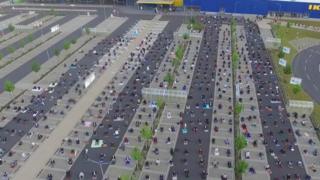
  • Ikea in Wetzlar, western Germany, let a local mosque hold prayers in its car parkImage copyright IGMG Wetzlar FATİH CAMİİ Image caption Ikea in Wetzlar, western Germany, let a local mosque hold prayers in its car park
    An Ikea store near Frankfurt in west Germany handed over its car park to a local mosque for socially-distanced mass prayers and won praise online.

    Around 800 Muslims prayed in the large outdoor space to mark the end of the holy month of Ramadan on Sunday.

    "The closing prayer with all Muslims in Wetzlar was like a reward for us," a mosque chairman told BBC News.

    Places of worship have reopened in Germany but they must follow rules to curb the spread of coronavirus.

    Pictures of the Eid prayer posted on social media have been widely shared, with many complimenting the mosque for finding a safe way for the community to pray together.

    Skip Twitter post by @AbdirahimS

    Eid Mubarak all✨

    Especially to this Ikea branch in Germany.

    Local Muslims asked if they can use the car park for prayers in order to maintain distancing per regulations. And Ikea said yes pic.twitter.com/6EDLmjkY9I

    — Abdirahim Saeed (@AbdirahimS) May 24, 2020 Report

    End of Twitter post by @AbdirahimS

    Looking for an alternative space to accommodate many people practising social distancing, the chairman of a Wetzlar mosque, Kadir Terzi, approached Ikea last week.

    He told BBC News he wasn't hopeful he would receive a positive response.

    "But the store manager didn't hesitate for a second and said 'yes, you can pray'. I was surprised and happy at the same time," Mr Terzi explained.

  • Over 40 Covid-19 cases traced to church service in Germany
  • Berlin church opens doors for Muslims to pray
  • Muslims celebrate Eid al-Fitr amid coronavirus
  • The mosque invited worshippers to bring their prayers mats and face masks to the Ikea car park, but reminded them of the German coronavirus rules that children under 12 should be left at home and people must keep physically apart.

    Image copyright IGMG Wetzlar FATİH CAMİİ Image caption Around 800 Muslims gathered for the Eid prayer organised by IGMG Wetzlar mosque

    After a shaky start with some crowding at the entrance, a video shows hundreds of people lying down their prayer mats at a distance from each other, aided by stewards.

    With the iconic blue and yellow Ikea storefront in the background, people wearing masks performed their prayers and listened to a sermon by the imam.

    Mr Terzi said the prayer was particularly important because many worshippers felt isolated during Ramadan due to coronavirus restrictions.

    Ordinarily the month of fasting is a busy time when families and communities gather nightly to break their fasts and organise charity work.

    "It was a completely different Ramadan month, without contacts, without visits and without breaking the fast together," he explained, adding that the chance to pray together was very valuable.

    The decision was praised widely on social media. Canadian journa list Carly Agro posted "this is the love and kindness the world needs right now".

    Skip Twitter post by @SNCarlyAgro

    Wow. This is the love and kindness the world needs now. Eid Mubarak to all celebrating! https://t.co/JU13HvAVHq

    — carly agro (@SNCarlyAgro) May 25, 2020 Report

    End of Twitter post by @SNCarlyAgro

    "What a lovely gesture. A true sign of hope in these difficult times," wrote another Twitter user.

    "This is what finding solutions together and staying by each other through this crisis can look like!" added another.

    You might also like:

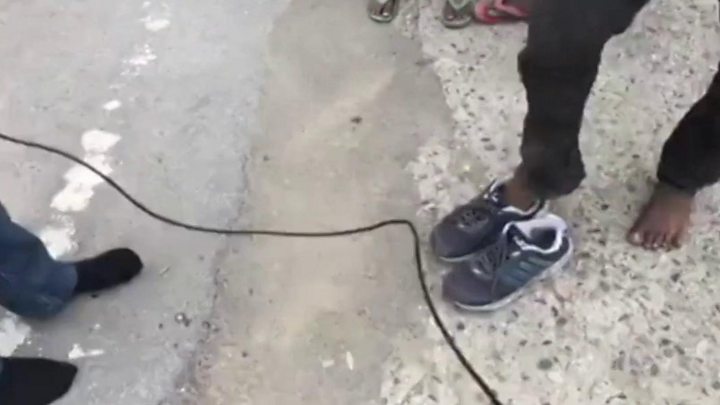
    Media playback is unsupported on your device Media caption"You take it, you have far to go": BBC reporter gives his shoes to a migrant
  • RISK AT WORK: How exposed is your job?
  • THE R NUMBER: What it means and why it matters
  • GLOBAL SPREAD: Tracking the pandemic
  • RECOVERY: How long does it take to get better?
  • A SIMPLE GUIDE: What are the symptoms?